Tag Archives: chronic fatigue

A dark brown wood piano is set against a cream, pale painted wall with paintings and pictures on it. The piano has a globe on the right handside and two piano stools. It's a traditional looking piano.

Finding my own meandering writing path

Being open to a little redirection and adopting a gentle ‘what happens if I try this instead’ approach.

My favourite spot to sit in the kitchen is on the sofa opposite our kitchen door. It opens onto the landing and the top of the stairs, the middle of our strange upside down house. It’s the perfect spot for watching all the comings and goings.

It also faces the piano, yet despite having played the piano from the age of seven to 18, weekly lessons, competitions, recitals and the like and always having a piano in the home, how often do I sit down to play, even a few simple scales.

Rarely, is the answer.

Around twice a year I might rifle through the piano music gathering dust on the shelves alongside our vinyl collection and choose a couple of pieces to leave propped open – currently Carol King’s Tapestry and Elgar’s Salut d’Amour – more in hope than expectation that they’ll draw me off the sofa and over to the piano stool.

I don’t know why this is. Why would I choose to slouch on the kitchen sofa and doom scroll over attempting the crashing chords and opening bars of ‘I feel the earth move’ or even a few simple scales.


I was nudged into action before Christmas though after an unexpected encounter with my old violin teacher, Lucy. More family friend than violin teacher, she was a constant, charismatic presence in our family for years and I hadn’t seen her for ages.

She taught both me and my sister Louise the violin, mum the ever present supportive parent and quasi older sister to Lucy.

I started learning the violin when I was about five because in a classic youngest child move I’d seen Louise being taught and fancied a piece of the action. Lucy would land on our front door on a Saturday morning, a chaos of violin cases, bags bursting with music ready to teach a steady stream of children before meeting up again after lunch at the music school in St. Albans for group lessons.

She introduced us to the Suzuki method which felt revolutionary with its emphasis on listening, observing others, practice – individual and group – and playing in public.

I saw her face registering sadness as she heard my mumbled response of ‘No’ to her ‘But you do still play the violin though? No? The viola? What about the piano. Tell me you sing at least Harriet?’

I love music. I play music all the time – I have a writing soundtrack that leans heavily on Ella Fitzgerald and Oscar Peterson. I’ll play Bach’s Concerto for two violins knowing that there’s a good chance it’ll make me cry. It’s in Suzuki’s Book 4 and other than copying Louise the main reason I wanted to learn the violin, but for reasons I’ll explain another day, didn’t happen.

I’ll listen to Bach’s Mass in B Minor because it reminds me of mum, even though I don’t know if she ever sang it in any of her choirs. I love Stevie Wonder, Aretha Franklin and have a thing right now for Simon and Garfunkel’s The only living boy in New York.

I share playlists with the children, and there are days where we silence Alexa and Spotify, preferring the drop of the needle onto vinyl on the turntable, even if it does mean eating Sunday roast while listening to a mournful Thom Yorke and Radiohead – my 18 year old’s choice.


Somewhere along the line though I became someone who only listened to music but since bumping into Lucy I’ve started playing the piano again.

My left hand tends to lag a beat behind my right hand, my brain struggling to read and process the bass clef as easily as the treble clef. My right hand slipping back into life on the keyboard with ease.

I guess the muscle memory is there, it’s just a little weak (to say the least) but I love it. I love the feeling of my fingers stretching across the keys, the sound I can create simply by pressing my finger down on a white or black key and my body moving with the music.

Pure joy and I can’t ignore how I feel it connects me to mum. She might not be here anymore but boy I feel her presence in so many ways and music is one.


That exchange with Lucy was the nudge I needed. I’d started to realise that so much (too much?) of my life was centred on words. I’d added writing to my reading habit. Writing used to be part of my job, then it became 100% of it. Then I started the therapeutic writing which then gave birth to the memoir writing project.

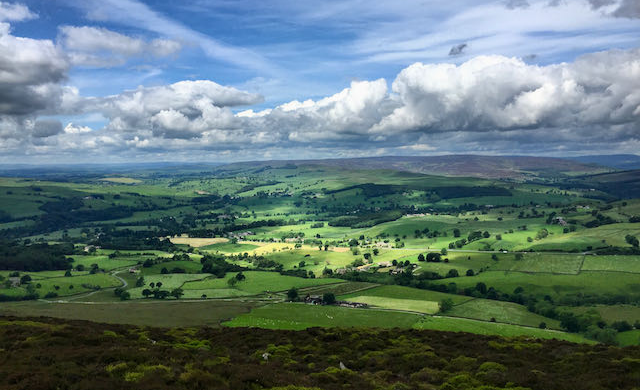
Even going for head clearing walks on the moor would be peppered with pauses to not only take photos of the sky but also tapping all the thoughts that big old sky had triggered into my Notes App.

I’d written myself to a standstill.


I then bought Jake Spicer’s ‘You will be able to draw by the end of this book’ when I popped into Salts Mill just after Christmas. I’ve never seen myself as being creative in that way, despite growing up surrounded with mum’s art, but I’d clocked the learn to draw/paint/sketch books on previous visits and this time thought, why not.

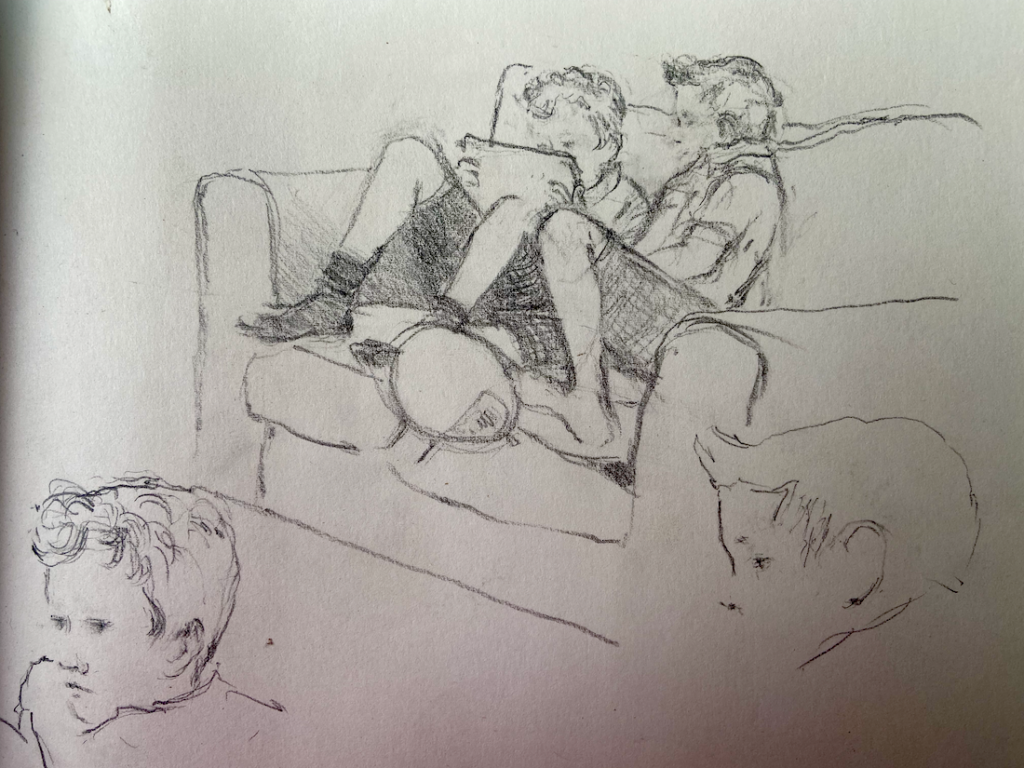
It’s still a pencil and paper but it forces me to pay attention in a way that I don’t normally, my eyes programmed to slide down the screen or paper.

And yep, mum. Again.


Was I done writing?

Short answer – I thought I was done but it turns out I’m not.

Longer answer – I’d set myself the challenge of finishing the first messy draft of my memoir by the end of 2023, I even wrote about it in Time to get my writing act together but I discovered that simply writing ‘Write about dad’s funeral’ or ‘Write chapter about starting chemo and losing my hair’ in my diary wasn’t enough to make it happen.

I was going through the writing motions but it was hard work and I hankered after past writing sessions where the dam burst across my notebook, pages soaked with words and feelings. I craved that feeling of catharsis and wondered if I’d written everything I needed to write.

I told myself that I could stop if I wanted to. I figured that working in Oliver Bonas over Christmas and New Year gave me a valid reason for pausing the project as well as something else to think about. Working outside the home was and still is a welcome distraction and an offer to stay on permanently accepted with almost indecent haste, ‘No really, I don’t need to think about it, it’s a yes from me.’


Silencing the writing chatter and not trying to get a book deal

I think what started out as simply me and my notebook at some point turned into a writing monster that I was fuelling by reading too many posts and articles about how to write, how not to write. How to grow your likes, engagement and followers. How to write a book proposal, how to land an agent, writers block – myth or reality?

It’s amazing how all the articles purporting to help ‘find your voice’ led to me losing mine.

It’s why I’ve turned to

Chris & Bec and their Writing Reset course and

Lindsay Johnstone and her Tuesday evening ‘Writing for mental and physical health’ workshops to help me find my writing path again. The rest is up to me…


Unfinished thinking and a gentle curiosity

If you’ve got this far, thank you. This has been one of those posts that started in one place hit a dead end, doubled back, took another turn and if I don’t hit send soon who knows where it’ll end up or if I’ll ever finish it.

I sometimes think I don’t have a problem writing, it’s more of a sharing what I write problem.

It might feel a little unfinished in its thinking but I hope that what comes across is unfinished in a gentle and curious way.

Thank you as always for reading,

Harriet

PS As ever, please forgive any typos and errors, I need to stop fiddling with this and hit send!

Whitley Bay lighthouse against a blue sky

The restorative power of a seaside circuit breaker

Six years after swapping coast for moorland I still feel the gravitational pull of the sea and the soothing rhythm of a beach walk.

I’ve been feeling a little I don’t know, autumn-y but not in the crisp blue sky and crunchy orange leaves kind of way. More grey and claustrophobic. The moor heavy, looming especially on repetitively dank October days.

I needed a seaside circuit breaker, but while my 14-year-old showed me photos of her friends in Spain this October half term, we headed to Spanish City in Whitley Bay via lunch with her brother in Newcastle for a blast of north sea air. Bracing.

Six years after moving to Ilkley from Bournemouth’s golden sandy beaches, I still feel the gravitational pull of the sea as strongly as ever. We (only) lived there for three years, half as long as we’ve been in Ilkley and far less than Bath, the city we’d moved from, but I quickly learned to love the simplicity of those beach walks. Daily circuit breakers on tap.

The beach was an easy five-minute walk from our front door, and the choice simple when we got there: walk east towards Bournemouth Pier, west towards Sandbanks or pause at Vesuvio and decide over a coffee on the terrace. I knew that whichever direction I chose, the sea, sky and beach huts would be there leaving me free to watch the shape shifting clouds and calm my nervous system.

Because we’d been there less than a year when mum died in May 2015, followed by grandma, her mother, in the August and dad a month later. Both parents and our last remaining grandparent gone in a few short months. Daily walks with Bella, our yellow labrador on the beach were already part of my routine but I think it was after dad’s funeral in the October that there was a shift.

I started having panic attacks. Rapid breaths and punches to the solar plexus would knock me to my haunches and I’d feel an overwhelming urge to get out of the house. To march down to the sea, knowing that my shallow, rapid breathing would slowly fall into a soothing beat in time with my moving feet, a steady four-four rhythm.

Gentle but with enough movement to stop whatever I was feeling from lingering in my body for too long.

I was also a couple of years into a chronic fatigue and fibromyalgia diagnosis and while my symptoms had alleviated – I was out of the sleeping 20 hours a day phase – and I could function, as long as I had fresh air and a sizeable siesta before school pick up (Charlie was 12, Ollie ten and Saskia six). But the additional layer of grief was threatening to tip me over to I don’t know where.

The rhythm of those morning walks with Bella became my bass line, a beat to keep me moving. I’d repeat mum and dad’s ‘one day at a time’ mantra as I walked, asking Bella ‘are we going left or right today?’ knowing that nine times out of ten we’d turn right and head towards Branksome Dene and Canford Cliffs. The white of Old Harry Rocks in the distance beyond Poole harbour, Sandbanks just tucked out of view. And we’d walk.

Walking in straight lines along the prom, picking out beach huts or cafes as markers to stop and turn around made these excursions with Bella easy when life felt anything but.

Because I felt utterly unmoored. This new home not yet familiar enough, new friendships not evolved enough to withstand this grief and my family foundations gone. But this landscape, the soft calm blues, greys and whites of the sea and sky, punctuated by lines of rainbow coloured beach huts was where I felt calm.

I started to see the same dog walkers each morning. I was on first name terms with the dogs, smiling and nodding terms with the owners and there was that small group of older middle-aged men who’d meet every morning at a beach hut at Branksome Dene Chine. I’d see them on my outward leg as they were chucking off their layers, running across the prom and sand into the sea, their chatting voices just heard above the waves. By the time I was heading back towards Alum Chine they’d be back at their beach huts flasks in hand, still chatting.

Hark, now hear the sailors cry,
Smell the sea, and feel the sky,
Let your soul and spirit fly, into the mystic.

Into the Mystic, Van Morrison

One of the group disappeared for a while and I wondered what had happened, my catastrophising brain coming up with all the scenarios, until one day he was back, now sitting in a wheelchair. I watched as the other men carefully lift him up and making a chair with their arms, gently carried him into the sea for a quick dip before returning to dry land. Such tenderness, friendship was beautiful.

We have no thoughts of moving from Ilkley, we’ve been here for six year and despite the tricky start of finding somewhere to live, breast cancer and Covid in the first few years I love it here, I love walking on the moor and it feels like home.

I used to love the flat walks along the prom, the certainty of placing my feet on the robust concrete surface, sometimes swapping for softer sand. It’s all uneven steps, rocks and sometimes slippery slopes here though. I think carefully about where I place my feet when I’m on the moor, and an abundance of paths to choose from depending on my mood and energy levels.

And the colours and textures too, it’s burnt copper ferns, orange leaves and grey-white sheep camouflaged as rocks right now, but then there’s the purple heather, blonde grasses and all the shades of green the rest of the year. It’s always changing but I do have favourite trees, little landmarks I like to check in on depending on the walk I’m doing.

Sometimes I crave the simplicity of those beach walks and head to the tarn or the riverside and walk laps. A flatter surface, water too, but it’s not the sea.

It’s interesting that in the last two visualisation exercises in the goal-setting workshops with London Writers Salon I’ve pictured myself in a whitewashed single storey home, large desk in front of floor to ceiling windows looking out to sea. It’s reminiscent not of our Bournemouth beach though, but the north east coast. These are my seaside circuit breakers now. Day trips to Saltburn-by-the-sea with its crayon-coloured beach huts, old school pier, fish and chips and crazy golf.

I love Seahouses and Beadnell Bay on the Northumberland coast too and then there’s Nairn and the highlands, this year’s summer escape, but for this half term a circuit breaker in Whitley Bay will more than do.

I started writing this when we got back from Whitley Bay, coming up with its shape, the things – roughly – I wanted to write in my head, but it’s proved harder to write than I thought. Our time in Bournemouth was challenging, the grief overwhelming even if the landscape was healing. But we left abruptly and I’ll never know how our life would have evolved if we’d had more time there.

Maybe there’s also a hint of ‘I can’t believe we left that behind’ that I don’t want to look at too closely. The move to Bournemouth from Bath and then from Bournemouth to Ilkley, both triggered by redundancy, are huge pivot points in my family story, overlaid with grief and loss and ill health.

Maybe going back to those years and re-engaging with those emotions and decisions is forcing me to shine a light on a period I’ve been happy to park, relegating it to wistful sighs over photos of the blue sky and sandy beaches, ignoring how much there is to unpack. Whatever it is, it tells me I need to keep writing it out and see where it takes me. So forgive me if this doesn’t flow, or there are gaps. It’s all a work in progress.

Memoir Watch: 90,000 words and counting

The good news is that I have a little under 90,000 words in Scrivener (the programme a lot of writers use to manage the book writing process) sorted into around 10 chapters.

I’m playing all the right notes but not necessarily in the right order

Eric Morecambe

The bad news is that while I have a lot of words written, they’re not necessarily the right ones or in the right order. It feels pretty lumpy at the moment. Too much focus on the ‘what happened’ in some areas, not enough ‘so what’ across the piece and some parts of the story barely touched but at least I know what I’m dealing with now. I ‘just’ need to keep going and I thank you for your messages of support, it does help!

With thanks as ever for reading, and please share your circuit breakers, beach or otherwise. I’ll be back in a few weeks and might even get round to a few book reviews! Harriet

Image is Malham Tarn on a bright sunny New Year's Day 2023. Bright blue sky and the sun reflecting off the water. There's a tree with bare branches on the right of the image and a sculpture of a large hare on the left.

Here’s to engaging our core and quietly creating new pathways

These blogs drop into inboxes the final week of each month, it’s a nudge to hit pause, put the kettle on and have a little noodle about life. I’d love you to join the Moor Musings community, we’re a friendly, welcoming bunch.

I made a pact with myself to start this year differently, because it just felt different. I even wrote about it calling it This year feels different. In it I talk about my intention to not hold life so tightly. To loosen my grip a little, but in loosening my grip I almost let this email slip by.

That, and an inability to read my diary properly. Not for the first time this year I’ve got my days and dates mixed up and honestly, I thought I had a while longer to write this. But no, look at that. January is almost behind us already.

Realising I had fewer days than I thought to put pen to paper has been good though, because it’s forced me to focus. That said, bear with me because while this makes sense in my head (kind of), it might not translate so clearly onto the page plus I’m in danger of over-editing what I’ve written. 

It’s also part of a bigger conversation I’m having about things like boundaries and emotions alongside today’s topic, core beliefs. Conversations I was struggling to get to grips with it until I remembered something my sister (the viola playing sister, not the gardener) told me a good few decades ago. But once I did, bingo and so I thought I’d share it here and see what you all made of it. 

Soften your knees, engage your core and breathe

If you’ve ever had the joy of standing on the tube as it careers through the underground do you hold your breath? Rigid, braced for the next jolt and sudden movement? Or do you flip flop and find yourself thrown across the carriage only to land in some poor unsuspecting traveller’s lap? Neither particularly comfortable, nor effective. Try this Louise said: 

‘Plant your feet on the floor, soften your knees,
gently engage your core and breathe with the movement.’

Grounded despite the jolts

I tried it and despite the jolting and jarring, swinging and swaying I felt grounded. Rooted, but not stiff or resisting the movement. Plus, I was breathing and I don’t know about you, but I have a habit of holding my breath without realising it. And the beauty, I’ve discovered, is that it doesn’t just work on the tube, it’s helped me in other ways too. 

Because while I was an expert at bending and flexing with life, I didn’t know where my core was, let alone how to engage it. But thanks to a series of insightful, probing conversations and this visual, I can now picture my sense of self, my values if you like running through me. I see that by actively engaging my core values, I can stand tall, while my soft knees mean I can move with life without always collapsing in a heap. 

It allows me to be open – to people and opportunities – but without sacrificing myself in the process. Better able to move with life, but with less falling over, or feeling so battered when things inevitably happen. 

But what does this have to do with writing?

I guess writing in my notebooks has allowed me to get comfortable with these ideas, roll them around and find a language that works for me. I’ve spotted recurring themes to explore. Writing has given me confidence and helped me to find my voice.

It’s not that my values or beliefs are new. My core has always been there, I’d just forgotten how to engage it. And now that it’s strong(er), I feel free to say yes and no with greater confidence and less guilt. Boundaries I’ve resisted enforcing for so long are now settling into place and it feels freeing, not restrictive. I’m finding it so much easier to be clear about my needs and wants – with myself and others. It’s been something of a revelation.

I think that with this clarity the detritus and white noise is falling away, paving the way for lightness and freedom, authenticity and honesty. I’ve stopped second guessing who I am or always looking to others for validation and permission – I’m beginning to find my voice. Maybe some of this resonates for you too?

“Some of us don’t want to be tough alpha leaders. Some of us just want to write and wander the garden and breathe in the sky and nourish and nurture and quietly create new pathways and live our lives as our art.
To know the earth as poetry.”

Victoria Erickson

And finally

I hope this makes sense, if not all of it, then some of it. And if in doubt, just remember to soften the knees, engage your core and breathe. It’s always good advice as many a Pilates instructor has said over the years. Thanks for reading, and here’s to quietly creating new pathways.

Harriet

Asking for help when you’re a coper

I wouldn’t be much of a writer claiming to explore life in all its messy glory (to repeat my own words) if I wasn’t honest enough to talk about the times when life is too much.

The reality is that I’ve been struggling for a few weeks now, months if I’m being honest. It started with some classic viral symptoms – headaches, sore throats, lack of energy, aching limbs – the usual. But they persisted and were joined by increasingly frequent bouts of tears and arguments about things like what to stuff the Sunday roast chicken with. Until one of my sisters gently suggested that maybe I wanted to think about finding someone to speak to. Someone neutral, a professional, paid to sit there and listen. I took note and started googling local counsellors, I even asked a friend, but didn’t get as far as contacting anyone.

Then on the back of a concerned comment from a colleague yesterday morning I rang the doctor and a few hours later was sitting in the surgery, in tears again, for no apparent reason other than the kind GP asked me to tell her what why I was there. A stream of symptoms emerged from my mouth, although I was annoyed because I’d left my list of symptoms at home and was struggling to remember the details, but no matter, the GP got it.

A full body MOT: mind, body and heart

She was superb. She listened, asked me questions and at the end suggested a bit of a body/mind MOT, starting with blood tests. She mentioned anti-depressants too, but emphasised that she wasn’t making any hard and fast decisions, but wanted to see what I thought. I’m not against the idea. I’ve taken Citalopram twice before, first back in 2009 around six months after Saskia was born, and again a few years later after I was diagnosed with ME/chronic fatigue.

I also had six CBT sessions back then, but didn’t find them particularly useful at the time, and I didn’t try again. I did have grief counselling after mum, dad and grandma died, regularly saw a friend for holistic therapy and had a few sessions with a counsellor at Maggie’s when cancer treatment finished. But I’ve never had long term, consistent talking therapy. And there’s stuff from my childhood alone that would scream, ‘you should talk to someone Harriet’.

The GP was clear about not jumping to any conclusions about any of it. We agreed that it would be too easy to assume that the chronic fatigue was back, or to blame menopause and tamoxifen for the physical stuff, and it was reassuring that she’s very much looking at my physical, emotional and mental health. I told her that I’d emailed a counsellor just before coming down to the surgery.

When self-care isn’t enough

I guess I have to face the fact that there comes a point where self-care just doesn’t cut it. But the difficulty is that I identify as a coper, it runs deep through my core. I hate the thought that I can’t, might not be able to cope because it’s not who I am, is it?

I remember mum saying that if I told her that I wasn’t feeling well when I was a child, she knew to listen, because normally I just trudged on, kept on going, coping. But as my sister pointed out in one of our WhatsApp exchanges yesterday, ‘there’s no need to put up with feeling low, no medals in that, as we know’. It’s just that it’s so much easier to nod along with the articles, podcasts, interviews and conversations about other people asking for help. Yes, absolutely, ask for help, don’t struggle on. Find someone to talk to.

But when it’s you, you’re the one finding life hard and can’t find the words to explain why, why the tears keep coming it’s different. I know I haven’t imagined the headaches, sore throats and viral symptoms, but it’s clear there’s something else going on too.

I know I’m not a failure, but that doesn’t stop me from feeling like one

I know I shouldn’t, but I feel like I’ve failed. It would be so much easier to blame a cold or virus rather than feel like all that work I’ve put in over the years to look after myself physically, mentally and emotionally isn’t enough. All those dog walks, Pilates and HiT classes, those morning pages and books I’ve read, podcasts I’ve listened to. That despite all that trying, just like those school reports I found in the garage a few months ago that said, ‘Harriet just needs to work harder.’ ‘Harriet needs to speak up and ask for help.’ ‘Harriet really needs to knuckle down now.’ It’s never quite enough.

The thing is, back then I was trying. Trying as hard as I could to keep going, working furiously beneath the surface while it was chaos at home. Living with an alcoholic father, a mother trying to survive, keep a roof over our heads, and food in the cupboards was not easy. I didn’t know how to ask for help back then and figured I’d just say quiet, keep turning up and hope things would come good. And seemingly no one at school twigged that maybe I needed something other than ‘try harder’ in my report either.

Trying hard and holding on

It’s not that surprising that the weight of the past few years will become too much at times, and that the events of decades earlier will crop up too. As the counsellor I’m seeing on Monday said in her email, ‘It sounds like you have been going through and also “holding” a lot of things’ and that was just on the back of a few sentences.

She was right about holding on.

Right here, this evening sat on the sofa watching the Lionesses play USA at Wembley I feel ok. But yesterday I didn’t, and I know that there’s a chance I won’t do tomorrow, and that’s why I’m taking a deep breath and asking for help. But I will keep on walking, and moving because heading out for a head clearer on the moor is never a bad idea.

Beach huts and big decisions

I’ve been meaning to explore this memory for a while and the first task in the Write a memoir course gave me the perfect opportunity to give it a go. The first part of the task was to draw a mindmap of our life and then write 300 words about one of those events or memories.

I chose this moment because it’s such a strong visual memory, but like a lot of the moments on my mind map, scratch the surface and there’s a lot more to it. So here goes, it’s part of a longer piece but I’ve tried to condense the essence of it into these words without losing too much context. This honestly started out as a happy memory…

I remember a time when…

I’ve sat here for the past couple of days trying to write honestly about that moment on Durley Chine beach in April 2014. But it’s taking me a while to unpeel the layers and move beyond the clichéd picture-perfect postcard view I saw that morning.

Because in that moment, looking out to sea it seemed obvious. After more than a year of leading separate lives, kidding ourselves that we could lead a harmonious, happy family life split between two locations I thought I’d found the answer. We needed to move.

I’d walked with Bella, our yellow labrador down the shaded woodland path to Alum Chine. Turning left to walk towards the pier I stepped off the prom onto the beach, sinking into the fine, golden sand. Bella darting in and out of the sparkling blue sea, a line of red, green, blue, yellow painted beach huts to my right. I smiled.

I stopped to grab a takeaway tea at Durley Chine and sat on a bench staring out to sea. My shoulders relaxed, I closed my eyes and thought, ‘What the bloody hell am I doing?’

We were struggling. Andy leaving Bath for Bournemouth at 7am every Monday, returning Friday evening. Me at home with the children, then aged 4, 8 and 10, but barely functioning. I had ME, was housebound and barely coping. I spent most days in bed, sleeping. Limbs heavy, brain scrambled, unable to process information, form sentences. Words floating away from me. The overwhelming need to sleep.

I hated it.

But as I dig into this memory, I start to see why deciding to move south – an easy sell on paper – was in reality so emotionally complicated.

In my overwhelming need to pull our family back together, I underestimated the importance of our roots in Bath. The first place I’d ever been able to call home and mean it. Our children’s home. Surrounded by friends, family. Loved.

Would we have coped any better with what followed had we stayed put? Would mum, dad and grandma’s deaths the following year have been any less traumatic if I’d been in my home of 13 years? Would the friendship that exploded a few months before we left, have survived?


So this is what I shared with the rest of the memoir writing group and our reader. I was nervous, waiting to hear what people thought. What they heard in my words.

Not only was this the first time I’d written about this specific memory, but it was also the first time I’d put myself in a position where my writing was going to be critiqued. We are a supportive bunch, all trying to do the same thing – write our story – or at least a part of our story, but you still feel nervous and vulnerable.

In search of a balanced life

How many life events do you need to go through before you become an expert in life change? I don’t know the answer, but I think I might qualify. From 2012 when I fell ill with ME / Fibromyalgia, to 2015 when my parents and grandma died in a four-month period. Then there were the two relocations in 2014 and 2017, followed by breast cancer in 2018.

And now lockdown. Learning how to keep on keeping on as each life event landed has been a constant since 2012. I’ve been on a search for balance and an end to the constant yo-yoing between the boom-and-bust cycle of fatigue and normality.

And this might be a feeling you’re familiar with too. One moment you feel energised and able to cope, the next – completely overwhelmed. So I figured I’d try and work some of it out by putting pen to paper.

Learning to ask for help

I’ll start by going back to 2013, a Monday lunchtime. Overwhelmed with fatigue, aches and pains, in the thick of ME and I was lying in bed having a full-blown argument with myself. I couldn’t decide whether I should ask a friend to walk the children home from school or make myself get up and do it. It went on for quite a while, the clock ticking down, getting closer and closer to pick up time. Getting more and more panicked the longer it took me to work out what the right answer was.

I phoned for help in the end but it’s a memory that has stuck. I didn’t like it. I felt like I was on a slippery slope – to what, I don’t know. I just knew that I didn’t want to be the person lying in bed, in the middle of the day having to ask for help.

I learned a few things that afternoon.

Firstly, ask for help. I know, I know! It has taken me years and I’m still not that comfortable with it, but during the acute phase of having ME I had no option. I relied on people to get me and the children through the day. Practically and emotionally.

Luckily, I had friends and family around me who were willing and able to help. I just don’t think any of us thought the acute phase would last as long as it did – several years as it turns out.

Secondly, I discovered that using up mental and emotional energy is far more debilitating that physical energy. I can walk for miles but give me a problem and I tend to keel over. I am an overthinker by nature, and these days Tamoxifen doesn’t help my anxiety levels either.

On the upside, I now know this plus, I’m getting better at recognising the triggers. I’ve also learned how to sit with these emotions, acknowledging and accepting them rather than letting them run riot.

The three energy buckets

But what really helped was a comment made by my GP not long after I was diagnosed. She described my three energy ‘buckets’.

  • Physical
  • Mental
  • Emotional

Back then preserving energy was the name of the game. Trying to avoid anything that would deplete my pretty non-existent energy levels. At my worst, reading was categorised as a high energy activity. And I could tolerate a gentle walk far better than a conversation.

My brain just couldn’t process information, find the words, or follow and remember a plot line. Brain fog was a huge problem.

It has taken years to get to this point where I feel like I have some balance and a deeper understanding of what makes me tick. Just having the picture of those three buckets has helped immensely. Visualisation can be so powerful.

Eight years on, my ME symptoms have massively reduced to a point where I think about how I can keep my energy levels topped up rather than trying to avoid running them down.

What works (and what doesn’t)?

Exercise fills all three buckets – dog walks on the moor, going for a run, Pilates. Whatever it is, the physical benefits almost go without saying. But having this time to clear the head mentally and emotionally is the bigger gain.

Writing – this is a tricky one. Sometimes writing is great because it can be so therapeutic. And I love writing for clients because I get to exercise my brain and put myself in someone else’s shoes for a while.

But writing be intense, particularly if I’m delving back into my back catalogue of life events. Warming up the brain, trawling through my memory and writing about it can be exhausting. Especially if brain fog descends.

Plus I’ve taken (what feels for me) a huge step in putting myself out there with Moor Communication. Creating a platform to publish my writing has led to some sleepless nights.

I worry about getting it wrong. I’m not sure what it is, but I still worry about it. Yet, each time I put something out there, I gain the confidence to write again. And so, the buckets fill up again.

Lockdown and the law of unintended consequences

One of the unintended consequences of lockdown has been having the time to take a step back and revisit my three energy buckets.

One big change has been to rethink my daily habits. I’ve changed how I exercise – shorter, more frequent bursts of activity seem to suit me better. And I’ve also started writing regularly. I now start most days with an hour of writing alongside other writers on Zoom thanks to London Writer’s Salon.

And, personally, and I don’t want this to be tone deaf, but this period of being at home has been welcome after all the change of the past few years. I’m in a privileged position where I can work flexibly and from home. As March lockdown loomed, I looked back over the past few years and thought, yup. I have a kitbag to help me get through this.

I still get fed up, annoyed, and frustrated. But I feel better able to navigate my way through these feelings and energy dips. I do push myself still, sometimes too much, but I’m also better at stopping myself just before I keel over.

Fatigue, the boom and bust cycle, it’s a huge subject isn’t it and one that I think so many more of us know a lot more about now, after the past couple of years.

Thanks for reading,

Harriet 

So, what happened?

What happened? What were the events from 2012 – 2019 that led me to writing here? I’ve had a go weaving it all into this one blog, but it’s quite hard because there’s a lot of ground to cover. So, here goes…..

I was chatting with a well-being coach yesterday. A lovely woman I knew years ago, first personally, then when our paths crossed professionally.

But we hadn’t spoken for a good few decades, and while she knew that I’d had breast cancer, as we began talking, or rather I began talking, I realised I’d need to list the stuff. All the things – or rather the headlines – of the 2012 – 2019 years. The years I think about whenever I think about this life writing malarkey. Which is quite a lot at the moment.

Once I’d got through the timeline and the conversation opened up, we talked briefly about why I’m writing. She observed that I’d smoothly talked about each event, one after the other, one year after another. A little commentary or explanation thrown in but speaking quite quickly. Rushing my words. Wanting to get it over. Conscious that as I spoke about one event, the next one was already lining up to be brought into the conversation.

So, while a big part of writing about this period in my life is to have a version – my version – of the story down on paper. I also want to move beyond the ‘what’. I want to use the reflective practice that’s been lodged in my brain since I first heard about in around 2011 to explore the ‘so what’ and crucially, ‘now what’.

But to do that, I need to actually write down the ‘what’. I’ve done this in bits and pieces over the years, but I don’t think I’ve ever written the timeline down. So, I figured that’s what I’d do, beginning in autumn 2012.

Autumn 2012: chronic fatigue and redundancy

We’re living in Bath, and I pick up a virus during the October half term, but I don’t recover. Chronic fatigue hits and I spend increasing amount of time sleeping, barely leaving my bedroom, let alone the house.

A few months into this and I’m diagnosed with ME/fibromyalgia. Around the same time Andy is made redundant and he juggles job hunting with looking after the children aged three, seven and nine, while I retreat from life.

January 2013: the lost year, Bournemouth, barely-functioning and mum’s cancer

Andy gets a job, which is great, but it’s in Bournemouth and our family life changes overnight. He leaves us on a Monday morning and drives to Bournemouth, living and working there til Friday afternoon when he comes home.

I’m at home trying to function, keeping the children fed and watered, getting them to school and nursery with the help of family and friends.

2013 is really the lost year. I can’t remember a huge amount about it other than I was barely functioning. And any functioning I was doing was thanks largely to friends, relatives and neighbours regularly feeding the children, having them round to play, adding them to their school run and generally stepping into in loco parentis mode.

Running alongside this – and this is where my memory is sketchy – is that mum’s cancer takes hold. She’d had a mole removed from her leg a few years earlier and had been under the care of a consultant ever since.

At some point in 2013 they discovered that the cancer had spread and was moving around her body in her lymphatic system.

She had surgery to remove lymph nodes and we shifted into new territory. She’d have an appointment with her consultant. I’d speak to her afterwards. I’d speak to my sister who went with her to the appointments and then I’d speak to my other sister and my brother, each conversation helping me to piece it all together.

There was a lot of talking and listening.

Alongside this, dad was needing increasing amounts of care at home, after having had a rocky period of ill health himself. TIAs, ongoing heart problems. He’d occasionally spend time in a care home, to give mum a break, respite. He went to a day centre, had a friend who’d take him to a weekly lunch club but by the end of the year, the situation was getting precarious as mum became less able to be his main carer.

As I sit here writing this, I’m incredibly aware that I really can’t remember anything about that year. Particularly around mum’s cancer. Or dad.

Spring 2014: cancer spreads, a friendship breakdown and a relocation to the seaside

We get to Easter, after a very low start to the year, and I take myself down to Bournemouth with the dog, the children safely stowed at my in-laws. I walk Bella along the prom, a beautiful sunny, blue sky, classic Spring autumn morning in Bournemouth. I sit to have a cup of tea, overlooking the sea and wonder why we’re breaking ourselves – Andy in Bournemouth, us in Bath. Barely functioning, no family life.

We decide in the space of a few days to relocate and move down to Bournemouth so that we can be together and live by the sea. It takes a few months to sell our house, find a new home and sort school places for the children but by autumn we’re back together under one roof, 5-minutes walk from the beach.

Mum has more surgery to remove more lymph nodes to try and keep the cancer at bay.

A significant friendship breaks down. There’s a lot of anger. It’s incredibly upsetting, and I can’t find a way through. It still haunts me. Less so these days, but it’s still a significant event in my adult life and this is the first time I’ve mentioned it in any of my writing.

Autumn 2014: breast cancer, a house move and mum starts to fade

My sister is diagnosed with breast cancer, and the conversations about mum’s cancer intensify. And it all feels very vague. I don’t really have a clear hold on her illness, what happened and when. It feels a lot like it crept up on us, by stealth. Silent.

Christmas 2014: grey and bleak end to the year

Christmas in Bournemouth, but the mood inside the house matches the uncharacteristic grey sky outside. My sister, post-surgery, part way through chemotherapy visits with her two daughters. My other sister comes to stay with mum. I think dad was in the care home and I don’t remember where Matthew was. This was the point where mum started fading. She was sleeping loads and had been on immunotherapy but was struggling with the side effects.

May 2015: Mum dies

August 2015: Grandma (mum’s mum) dies

September 2015: Dad dies

I can’t say anything else at this stage about 2015. Let’s just leave it there, with those three deaths. It’s a year I will return to.

2016: finding peace and getting back on my feet

This year was all about getting back on my feet. I started volunteering at my daughter’s primary school, reading with the children in reception. I became a reading coach for adults and by the end of the year had a job working as a part-time special educational needs teaching assistant.

This was against a backdrop of my brother relocating to Japan. My eldest sister, who had met her now husband just months before mum died, married him. Happy news.

Spring 2017: redundancy and saying goodbye to the sea

Andy is made redundant and starts job hunting. There is little in and around or commutable from Bournemouth and he ends up taking a short-term contract, working with an old contact and friend up in Yorkshire.

He drives up on a Sunday, works til Thursday and comes home. Not ideal for the long term and we decide to relocate to Yorkshire.

Bonkers? Maybe. But I don’t think we could see any other option at the time. Our eldest was heading into Y10 and GCSE territory, our middle child in Y8 and our youngest in primary. We either made the move there and then, or we spent two years living apart while the eldest completed his GCSEs. We decided to move.

September 2017: move to Yorkshire

We move into a rental in Ilkley and start house hunting. The rental isn’t a great set up for us, and our belongings are spread across packing boxes in Yorkshire – in storage and in the rental garage, as well as in our Bournemouth home. We try to settle the children into their new schools. It has its challenges.

Spring 2018: breast cancer

In April, I find a lump in my right breast and I’m diagnosed with ductal-invasive breast cancer. I start nine months of treatment: chemotherapy, surgery (twice) and twenty rounds of radiotherapy.

We also, eventually, sort out the house situation, and move into our now home in the July, partway through chemotherapy.

2019: another lost year

I start the year by finishing cancer treatment and slide into work. The work grows but I’m increasingly hitting the buffer: physically, emotionally and mentally. Overwhelmed with everything. Not just the cancer, but the relocation, the deaths, everything. Missing mum.

Andy is also made redundant and starts job hunting – again.

January 2020: new job and Maggie’s to the rescue

I limp through to 2020 and visit Maggie’s Cancer Centre starting the post-cancer ‘Where now’ course which finishes shortly before Covid strikes. Andy begins a new job in Manchester.

Honestly, this is the bare bones. As I jotted down each year and the headline events, I was aware of questions and emotions bubbling up. Some to the surface, that I haven’t included here but will noodle over the coming days.

I’ve written this off the cuff, not over thinking it. Just seeing what pops up. I’m certain that when or if my siblings or husband read it, they will have different recollections. But sitting here, right now, thinking back to those years. These are the events as I remember them.

Thanks for reading,

Harriet