Tag Archives: book review

What to read in March (fiction)

This book review is long overdue, from the new year if I’m being honest. I’m sorry, life got in the way. Reading more books also got in the way but I guess the fact that I read these books a good few months ago and I was still able to remember them and how they made me feel is a pretty good recommendation in itself.

I think my next book review/recommendation might be non-fiction though given how laden my shelves are with cracking non-fiction reads right now. In the meantime though, happy reading and I hope you find something you like in this list!

The Immortalists: Chloe Benjamin

A total spur of the moment purchase in Cardiff Waterstones at Christmas while my sister was off shopping with my 13-year-old. I grabbed that hour or so and headed straight to Waterstones, and struck lucky in their Christmas / New Year sale, managing to limit myself to just two purchases. This and Elizabeth Strout’s Lucy by the Sea (featured below) before heading straight up the staircase to the cafe.

On face value The Immortalists is a novel route into telling a family story and whilst it grabs your attention from the get-go, the whole ‘young children go to visit a psychic who tells them when they’re going to die’ moves backstage as you sink into each of the four children’s stories.

It is the thread that binds the family story and never disappears completely, but despite struggling to get through the opening scene setting sections, once I got into Simon’s story, I was hooked, and it turned into the texture-full page turner I wanted and needed it to be.

It’s so richly described with quirky characters and enough pace to keep me interested. I love how the different characters came in and out of each other’s lives and stories. Not just the siblings but other characters too, the thread that pulled the story together was there but not overly so. It’s clever, but so very readable.

Don’t let the whole psychic ‘I’ll tell you when you’re going to die’ put you off. Each time I’ve described this book I’ve been greeted by scrunched up faces. I mean, who does want to know when they’re going to die…but if you want a richly described story of a gloriously dysfunctional family and be transported from east coast New York to west coast free loving San Francisco via Las Vegas then go for it.

Lucy by the sea: Elizabeth Strout

I adore Lucy Barton, I have every single one in the series. I love the cover sketches, reminding me as they do of a sketch, I have on my wall that mum did many years ago. Lucy by the sea is set on the cusp of the pandemic, and the protagonist is being persuaded by William, her ex-husband and the father of her daughters, to leave Manhattan for a house he’s found on the coast near Maine. It was strange reading about a period so recent yet feeling so long ago. It’s that Covid playing havoc with our concept of time again.

We follow Lucy and William as they adjust to living together as not-quite husband and wife again. We walk alongside them as they both cope with and reflect on the lives they’ve lived independently of each other since divorcing years earlier, yet still always connected by their daughters. A situation a great many people can empathise with. Life is messy, isn’t it?

What I love about the Lucy Barton books is also what frustrates me when I start reading them. Lucy’s voice. She is so uncompromising as a character and the books are written totally, absolutely 100% in both her spoken and internal voice. It always takes me a while to adjust at the beginning of a read because it can feel clunky, pedantic.

Each. Word. And. Each. Thought. Separately. Written. And.Communicated.

But it’s not the writing, it’s Lucy and it’s so, so clever. The detail and minutiae Strout goes into in order to bring Lucy (and William) into the reader’s head is quite something. It can also feel suffocating because we are most definitely in Lucy’s head and I’m not sure that’s somewhere I really want to hang out. At least, not for too long.

That said, I love Elizabeth Strout and I’ll always make space for her and Lucy on the bookshelf.
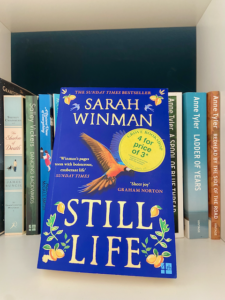
Still Life: Sarah Winman

This had been on my to read list for most of last year as a succession of friends raved about it but I held off as I worked my way through other reads, but finally the cover drew me in. It is beautiful and that certainly helped my buying decision, but in all honesty, it was a read of three thirds. The middle third I was hooked, having got to know the ensemble cast and followed them post-WW2 from the east end of London to Florence. I really was with them, and it was an absolute joy spending time in their company. Especially the chapters in Florence where I was truly transported and found myself on the verge on more than one occasion of buying myself a one-way ticket. But getting to that point and the ending left me frustrated. I just wanted to stay in that middle third. In fact, it almost felt like a couple of books that had been shoehorned together.

I felt Evelyn was a strong enough character to hold a story and book in her own right and so did Ulysses. I can see how their lives entwined and how that gave the story hooks and angles, but I felt the story ended naturally with Ulysses in Florence. It was a jolt to then start reading about Evelyn and Miss Skinners’ lives and honestly, I gave up. I wanted to be in Ullysses’ Florence. That said, I was absolutely transported to Italy and thank Sarah Winman for that escape during a dark, dank British winter.

Small things like these: Claire Keegan
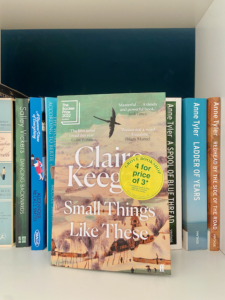
I was late to the Claire Keegan party and in all honesty, I need to read ‘Small things like these’ again. I think I slipped it in between other reads, and because it’s such a short book and because I read so quickly, I don’t think I took enough time to savour the sparseness of the writing.

The confidence and ability to tell a whole story in fewer than 120 pages is a lesson in how to give the reader time and space to take in the words that have made it onto the page. To linger with them and the space around them. To fill the gaps themselves and tap into their own world and imagination to picture the characters, setting and feel the emotions themselves. I’ll read it again but next time I’ll take my time and make sure I read each individual word.

Honourable mentions

I found myself in a Val McDermid mood the other weekend and read 1989 and Still Life in quick succession. I’d read Still Life before – a Karen Pirie story if you’ve seen the ITV series and not to be confused with the Sarah Winman Still Life mentioned earlier in this blog.

I’d also read 1979 the prequel to 1989, introducing a new McDermid character, journalist Allie Burns. With storylines less murder focused and with more of a social and historical angle, there was still that classic Mc Dermid underbelly and the knowledge that death and intrigue would appear before long. Classic weekend page-turners.

I’ve also just finished The Fear Index by Robert Harris (picked up in the library), which was a new one for me, but I went for it after some book club chat. A perfect page turning read.

Pile of three books: The Lido by Libby Page, Standard Deviation by Katherine Heiny and The trick to time by Kit de Waal

Three December reads


The Lido, Libby Page, Standard Deviation, Katherine Heiny, The trick to time, Kit de Waal

I haven’t written a book review for months. It’s not that I haven’t been reading, I have. The crime shelves of Ilkley library were my go-to for weeks back in the autumn as I found myself working my way through the detective novels of a previously unknown crime writer, Ellie Griffiths. I’d discovered her when plundering the shelves of my sister’s village book exchange during my September Somerset retreat. I read one while I was there and brought another back with me. Her novels, are in the same vein as Ann Cleeves or Val McDermid, featuring murders, flawed characters who infuriate you as much as your own family, and the other main character, the location.

I haven’t been to the Norfolk coast since a family summer holiday when I was about eight. I remember the farmhouse and its orchard. My incredulity as an oh-so mature eight-year-old that my six-year old cousin didn’t know who Elvis was, still less that he’d died the year before (there was an Elvis documentary on the TV, I hadn’t randomly started up a chat about Elvis), and the fact that my brother and I developed mouth ulcers because our grandparents had a never ending supply of boiled sweets they kept feeding us.**

So, if you fancy a straightforward crime novel with a coastal location, give Ellie Griffiths a go, and if you fancy visiting Shetland or Northumberland, go for Ann Cleeves, Val McDermid for Scotland. But this review isn’t about them. It’s about the novels I read once I’d had enough of the Norfolk’s fens and murder.

Because as much as I enjoy a crime page-turner, I needed waking from my reading stupor, and it happened while in Waterstones in Leeds a few Fridays ago. It was an impromptu end of the week afternoon trip into the city with a friend and we took in all the middle-aged sights, John Lewis, the Corn Exchange and Waterstones before finishing off with a bottle of rose and Spanish sharing plate at Friends of Ham. It was the perfect way to finish the day. I digress.

Standing in Waterstones we tried to remember the name of the book that had been recommended less than 24 hours earlier at a long overdue book club chat. As we were trying to remember the author’s name, ‘Was it Jane something?’ ‘No not Jane, hang on, I can remember the cover. Did someone share it on WhatsApp?’ and wandering around, I spotted The Lido by Libby Page. That wasn’t the book we were looking for, but the clear blue cover cut through my foggy head, and I picked it up, vaguely remembering having seen the title before and carried on my wander.

‘I’ve found it. It’s Standard Deviation by Katherine Heiny.’ I called across the shop, holding another blue covered book aloft. But there’s only one copy. Sorry,’ (not sorry) and on my way back to my browsing friend, passed a table with a pile of Kit de Waal’s A trick to time on it. I’d been looking at the blurb on her memoir a few minutes earlier whilst trying to remember if I’d ready ‘My name is Leon’ and picked it up. It too had a blue cover.

Three books with blue covers. Coincidence. Maybe, but I do find myself reading books that look alike. Strange? Anyhoo, here’s what I thought. In short, I thoroughly enjoyed them all. Three very different books, different takes on life, different characters, but each one a worthwhile read.

The Lido, Libby Page

The Lido, Libby Page: Of the three, this was the most straightforward read. I could tell where the story was going, but that’s ok. Sometimes you don’t want to have to guess, you just want someone to guide you by the hand and show you want a gentle version of a life that feels familiar enough that it touches you, but not overly so. In a nutshell, a south London lido is threatened with closure.

Kate, a young journalist is asked to cover it for the local paper, and she meets Rosemary, an octogenarian who’s swum at the lido every day for decades and is behind the campaign to keep it open. I suspect there’s a bit of Kate in lots of us, anxious and uncertain how or where we fit into the world. And I also suspect a lot of us would like to have Rosemary’s determination and strength of character in our eighties too. The friendship between the two is rather gorgeous and shows the kind of warm, supportive community that I think we’d all like to have around us. It’s gentle, kind and sweet, but not saccharine. A lovely read.

Standard Deviation, Katherine Heiny

Standard Deviation, Katherine Heiny: I picked this up as soon as I put The Lido down. If The Lido is soft and gentle, Standard Deviation is sharp and direct and brilliant. If you love Maria Semple and Meg Rosoff who featured in The big summer read, give this a go. The story features Graham, his second wife Audra and their son Matthew who live in New York, and a revolving cast of characters who come to both visit and live with them. Audra is quirky, charming, never stops talking. She can’t help asking and sharing what some (like her husband Graham) might consider inappropriately intimate details and inviting people into their family.

Graham gives the appearance of a man who can’t quite work out how he’s ended up in this situation, living this life. Living in an apartment with Audra, a son he loves, but doesn’t quite know how to parent, and a revolving cast of characters he keeps tripping over. I absolutely loved this book. The sharp writing and observation, the clever similes and metaphors that brought the story and characters to life. I might not live in a New York apartment, but I could connect with the characters and the story. A book I nodded, smiled and laughed through.

The trick to time, Kit de Waal

The trick to time, Kit de Waal: Trigger Warning: the story involves baby loss.
The subject matter is tough, there’s no getting around it, but it isn’t a tough read because it’s written so beautifully, so tenderly and sensitively. I love Irish writers like Colm Toibin and Sebastian Barry, and I’m adding Kit de Waal to the list. I don’t know what I was expecting, even having read the reviews on the cover, but I didn’t expect to feel myself feeling like I was walking alongside Mona from the first page. I love writers who can blend gentle and piercing prose, juxtapose the cadence of the Irish accent and turn of phrase with the immense life events in the story.

There’s the contrast of the Wexford beaches from Mona’s childhood where she experienced grief and loss at such a tender age, her early adult life and love story across the Irish sea in Birmingham in the mid-1970s. How we meet her living in an unnamed English coastal town in her middle life, bereft and grief stricken. It is that beautiful thing, heart breaking yet with an undercurrent of hope and glimmers of happiness. How life can be fragile yet people so resilient.

I don’t know if there’s a word or phrase that adequately describes that feeling where you don’t want a book too finish. Where your reading pace slows and you close the book for the final time with a sigh, wishing there was another volume waiting for you. Love, love, love. My kind of read.

**When I say they kept feeding us, I mean we found their tin of boiled sweets which we helped ourselves to with regularity.