Category Archives: Moor Musings

You can’t edit a blank page

This went out to Moor Life Writing newsletter subscribers on Friday 30 June, if you want musings on pursuing a creative and writing life to drop into your inbox without having to go looking for them, drop me a note and I’ll add you to the list.


Greetings from a sunny Somerset! I escaped Yorkshire a week ago to dog and house sit for my sister who’s on her own escape to France. I had vague plans to write and do as little as possible in between dog walks, watering the garden and Netflix’s latest offerings.

The first thing I noticed was the difference between walking my dog Bella, a labrador, and Maisie, a slightly smaller cavapoo. Let’s just say my idea of a dog walk and Maisie’s are slightly different but she’s coped admirably with my route marches round the village lanes.

That said, my pace did slow to almost match the trundling tractors brushing the impossibly tall hedgerows rather than the helicopters that were whizzing overhead last weekend, transporting the rich and famous to and from Glastonbury.


Writing when there’s no client or deadline or goal

The things is, when I’m not writing blogs and email newsletters and the like for clients, I write creative non-fiction and memoir. But there can be quite a mental shift going from one to the other.

Writing for clients involves taking time to really understand the audience so that I can write clear, specific messages in a certain ‘brand voice’. And the writing has a goal. A ‘call to action’ whether it’s to get in touch, make a booking, introduce a new service or demonstrate expertise.

But when I write for me, it’s different. No one has asked me to do this writing. It’s something I want to do, choose to do. There is no specific audience, and the focus is on the writing.

I love mining the memory, painting scenes and memories with words. Weaving in moments of reflection. I write not to produce a book, or even a blog. I write and see what happens. Some of the writing ends up here, other times it turns into a blog or something I read out at writing group. There’s also an increasing pile of files and folders saved on my Mac with the name Memoir, but a lot never sees the light of day. 


I do it because I enjoy it, it’s almost that simple. I enjoy pulling at the threads and blending words together to tell a story. I love days like yesterday where I started writing in my notebook in the morning, and after two solid writing stints realised I’d probably written not far off 5000 words.

But how do you motivate yourself to write when you don’t have someone giving you a deadline, and when the sun is shining, there are books to be read and there’s a bench in the orchard just begging to be sat on?


What worked?

#1000 words of summer: I signed up for this Jami Attenberg’s writing sprint last summer and it worked so well, I signed up again this year. A commitment to two weeks of writing 1000 words a day in June with a massive Slack community for accountability and daily letters from Jami to keep us going. The timing was perfect and I started a few days before coming to Somerset. I tend to write every day but have been struggling to consistently put a decent number of words down. This was the nudge to get me going.

“Today you will write 1000 words. Because life is a gorgeous and whirling mixture of sounds and images and feelings, and writing these words is one of the best ways for you to access it, participate in it, contribute to that joy, joy, joy. Because you are a writer. That is what you do. That is how you connect to it all.”

Jami Attenberg, #1000wordsofsummer, Day 13 

Writing down the bones by Natalie Goldberg: This has been on my to-buy list for yonks and if you’re remotely interested in writing, putting any form of words down on paper – poems, short stories, anything – then this is a great read. I’m only a few chapters in but it already feels like Natalie is that invisible good angel on my shoulder, gently but firmly encouraging me to just get the words down and not worry if they make sense or not. The idea is to write with freedom because let’s face it, you can’t edit an empty page.

“Through practice you actually do get better. You learn to trust your deep self more and not give in to your voice that wants to avoid writing. It is odd that we never question the feasibility of a football team practicing long hours for one game; yet in writing we rarely give ourselves the space for practice.”

Writing down the bones, Natalie Goldberg

Written, Bec Evans & Chris Smith: By fellow Yorkshire dwellers over the way in Hebden Bridge, Written is brilliant for anyone interested in getting things done. It might be written with writers in mind, but if you’re remotely interested in starting any kind of creative hobby, project or activity and crucially, want to keep going then this is a great read.

I love the chapter that explores how people fit writing into their lives: spontaneous for people with unpredictable or packed calendars, daily writing – same time, same place as loved by lots of productivity gurus. Binge writing – rare but productive writing sessions like a retreat or sabbatical and time boxing, a very practical approach where writing is scheduled in and around life’s many demands.

It has a foreword by Oliver Burkeman of Four thousand Weeks fame and you can hear them talking about their approach to goal setting and keeping going here with London Writers Salon and here with Helen Perry. Well worth a listen.

“Noticing how you write and taking a more mindful, experimental approach to what works for you and what doesn’t is the most powerful thing you can do to gain a happier, healthier and more productive relationship with writing.”


Written, Bec Evans & Chris Smith

The result?

I’ve less than 24 hours left in Somerset before I start the long drive north, and it’s been a success. A combination of sheer bloody mindedness, a daily writing goal and having Writing down the bones and Written on my desk means that I’ve had a few breakthroughs. I’ve written loads of words which gives me plenty of material to work with. And I’ve had loads of time to read, rest and recharge too.

Onwards to the weekend and home in time for Ilkley Cycle Races I hope, and to see the family. I’m sure they’ve missed me, I mean, I’m sure they noticed my absence….

Til next time,
Harriet

View of lush green trees hanging over a sandy path heading up the moor with blue sky in the background

Read, write and keep going

Are you basking in the warmth and blue skies that have finally decided to join us in the UK? Please reassure me it’s warm and sunny where you are too? It’s the small things I love, like feeling the warmth when I open the kitchen to let the dog out in the morning. The shedding of layers and relaxing of shoulders, unfurling like the ferns on the moor.

I was going to write about our Ilkley writers group Spoken Word event which was equal parts nerve wracking and fun. As in the words on a page versus speaking them out loud to an audience but then I watched a live Podcast recording with Maggie O’Farrell on Wednesday (with a few hundred others thanks to Arvon and LWS ) and listened to Reshma Ruia talk at an in-person event last night and it sparked a few other thoughts.

Because listening to writers talk about their work, their path to publication is probably one of my favourite social activities right now. If it’s in-person like last night at our local bookshop it tends to start at 7pm, there’s a glass of wine, friendly faces and we sit and listen to lovely people talk openly and honestly about their writing. The audience asks a few questions, buy a signed book, a bit of chit chat and home by 9pm. Perfect.

It’s never not uplifting, even, especially if it’s an author I’ve never heard of or maybe a genre I’m less familiar with. The thing with writing folk – as I’ve learned – is that we’re obsessed with how others write and how people are published, often a fascinating story in its own right.

Because talk about playing the long game. You hear stories of rejection after rejection and stubborn perseverance. Dogged determination to write the story, nurture it, bring it back to life after long periods of hibernation as life (and rejections) get in the way.

It’s not unusual to hear published authors say it’s taken them years, decades sometimes, for their words to be published.

In Reshma’s case it was also because publishers had (and arguably still have) a very fixed view of what a South Asian woman should write about, and it wasn’t what was in her manuscript. Linda Green shared that she had 102 rejections before her ‘first’ novel was accepted (it’s rarely the first novel written, just the first that’s been accepted), and she’s gone on to sell something like 1.4 million books.

‘You learn so much with each book, but it’s what you teach yourself by writing your own books and by reading good books written by other people – that’s the key. You don’t want to worry too much about other people’s responses to your work, not during the writing and not after. You just need to read and write, and keep going.’

Maggie O’Farrell

Universal themes often crop up that are relevant whether you write or not. Resilience, vulnerability, creating habits, practicing the craft, finding your voice. These are the thoughts swirling around my head from this week’s talks as I sit and write to you.

  • Keep going. Don’t worry, don’t even think about where the words might go after you’ve written them. Because they won’t go anywhere if you don’t actually write them.
  • Put yourself in the picture so that you can paint it for the reader. O’Farrell said she learned to fly kestrels, planted all manner of medicinal herbs and walked the pavements of Stratford on Avon when writing Hamnet. Show, not tell is the mantra you’ll hear trip from many a writer’s lips, describe the scene, the memory, the feeling. 
  • Most of the writing doesn’t happen at the desk, it happens when you’re washing up, putting the kettle on, having a shower, walking the kids to school, standing in the queue at Tesco. Getting up and walking away from the desk is where you untangle the knots and give space for ideas to float to the surface.
  • Relish the writing challenges, embrace unknotting the knots because it’s all part of the writing process. It’s how you peel away the layers and get to the good stuff. Stick at it in other words.

So let’s keep going and learn to love the process. And here’s to many more days of warmth and sun, and here’s to anyone supporting a young person through exams right now. Our middle child is in A-Level season. This isn’t our first A level rodeo but as ever, different child, different experience, different levels of tip toeing around the house.

Thanks for reading, Harriet

Image is of an open notebook with two facing blank pages. It's sitting on a tile table top, with different mediterranean patterned tiles

Finding joy on the blank page

I was on the hunt for a spare notebook the other day and found one buried at the bottom of a drawer. Flicking through the pages I was struck by how neat and upright my writing was compared to more recent messy scribbles that pass for my handwriting. It was all a bit tight, a bit too neat given it was meant to be the midweek scribbles of someone dealing with some major life stuff.

I felt myself holding my breath as I skim-read the sentences and couldn’t help but think that even in this notebook, a notebook for my eyes only that I was probably focusing far more on filling the page with ‘the right thing’ than writing what I really felt or needed to say. Slightly missing the whole point of free writing.

It’s the silent self-judging that trips us up, isn’t it? I vowed in January to hold this year more lightly, to dial down the judging and dial up the lighter, experimental, have a go attitude. Because all too often where you find creativity, you’ll also find self-judgement and self-sabotage.

It’s why I’ve been approaching writing with ‘experiment and practice’ in mind and learning to trust the process, and enjoy the sight of a blank page rather than seeing it as a path strewn with invisible traps to trip me up.


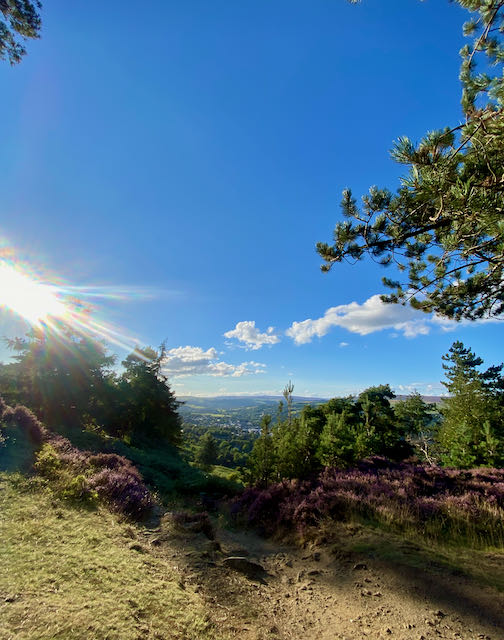
Summer evening on Ilkey Moor green leaved trees, purple heather and grasses. The Sun's rays visible on the left hand side, a few white clouds dot the bright blue sky

It’s why I like to think ‘breathe into your words’ and post photos of the moor whenever I get the chance. Anything to remind me – you, us – to take a deep breath and roll the shoulders before diving in with the pencil.

Because the chance to write is an invitation to connect, whether it’s with yourself through free writing or journalling or with another person.

And what could be better than connecting with someone? Unless you’re appealing a parking ticket or writing a letter of complaint. Although having been to two Letters Live events now where gloriously, uproariously funny letters of complaint were read out, I’d argue that you can get creative and have a lot of fun writing them too.


But something happens in between acknowledging the thought or idea in our head and what appears on the page. I was going to say I wish I had a magic wand so that we could miraculously pass through this part, but the reality is that those awkward first few words that land on the page are so valuable.

They’re our warm-up, it’s where we get to explore and poke our nose into all the dusty corners. It’s where we establish a steady, deep breathing pattern that we take into our words. Bonkers? Maybe, maybe not but what have you got to lose?

Breathe: find a way to do the writing equivalent of rolling your shoulders and taking a few deep breaths as you move the pencil across the page. Whether you’re writing a proposal, email or article: breathe first and then smile.

If you do need help limbering up because the sight of a blank white page fills you with dread, try a writing prompt to get the words and creative juices flowing.

  • Write no more than 50 words about ‘home‘ and think show, not tell. Describe and tap into all the senses.
  • Set the timer for 5 minutes and finish this sentence: ‘I wish I knew how to…‘
  • Set the timer to 5 minutes and write down everything you can see, touch, hear, taste and smell.

Embrace the white space: swap A4 for A3 and turn the notepad landscape. Or go small, if you tap into the laptop, try tapping into notes on your phone instead while the kettle boils or set a timer for five minutes and just write out the recurring thoughts in your head, whether obviously connected to the piece you’re writing or not. Move to a different room, stand up and lean on the kitchen counter and write. Just shift your view and try something different.

Dig out the Thesaurus and the dictionary: have fun with the words, we have so many brilliant words at our disposal, sometimes we just get a little stuck with the same ones. I bristled at all the ‘don’t use a thesaurus’ posts that did the rounds on LinkedIn not that long ago. Bonkers (or bananas, gaga, loony, crazy, bats – thanks Thesaurus). Let’s use them to spark our imagination and help us find to find our voices rather than just regurgitating other peoples’. There has to be an alternative to ‘smashing it’ and life gets dull when we all use the same phrases, so let’s explore and have some fun as we do it.


“We tend to think that what we’re making it the most important thing in our lives, and that it’s going to define us for all eternity. Consider moving forward with a more accurate point of view that it’s a small work, a beginning. 

“The mission is to complete the project so you can move on to the next. That next one is a stepping stone to the following work. And so it continues in a productive rhythm for the entirely of your creative life.”

Rick Rubin via Sheryl Garratt from The Creative Life

Trust yourself, enjoy the process and just write

It’s too easy to leap ahead and get wrapped up in the ‘what next?’ and the end product, rather than relishing the chance to write and be creative for the hell of it. So embrace and learn to love the blank page, relish in writing outside the lines and feel free to remind me of this if you ever come across me staring blankly at an empty white page!

Thanks for reading, Harriet

View of the stage at the Royal Albert Hall at the finale of Letters Live. A group of actors and celebrities are gathered on the stage under a sea of lights.

Discover Moor Musings, my monthly email newsletter

Writing habits and looking for chinks of light in the November sky
Moor Musings, November 2022

Asking you to sign-up to a newsletter when you don’t know what’s in it and whether it’ll have anything of interest or use is a tough sell, so I figured I’d share the November 2022 Moor Musings so you can get a feel for it. It goes without saying that I’d love you to sign up.

Interesting and inspiring as ever. My only slight frustration is that I read the musings and there are always points where I’d like it to turn into a conversation with you! I’ll have to remember for our midday coffees. 

Moor Musings subscriber*

If, after reading Writing habits and chinks of light in the November sky you fancy getting the newsletter straight into your inbox, drop me a note with your email and I’ll add you to the list. I send it out once a month-ish, usually on a Friday morning and there’s no hard sell, no hacks or top tips, just a gentle conversation about writing and life.

Think of Moor Musings landing in your inbox as a sign that it’s time to down tools, put on the kettle, have a brew (and a slice of cake) and take five.

* I’m always available for a coffee and a chat!

Links to other editions of Moor Musings

October 2022 Moor Musings
Rediscovering the library, muting WhatsApp and searching for the perfect Autumn tree

September 2022 Moor Musings
Breathe into your writing